A coordination platform for the organizations managing care after the hospital. One record. Many caregivers. Every obligation visible to everyone who needs to see it.
A patient discharged from the hospital arrives home with a care plan, a medication regimen, follow-up obligations, and a body that is still recovering. The home care agency receives a summary. The coordinator builds a schedule. The caregiver follows their list. Nobody has the full picture across all three at the same time.
Scheduling software doesn't carry clinical context. Care plan software doesn't update in real time. Documentation tools don't communicate with the coordinator hub. The patient's care cycle is fragmented across systems that were never designed to talk to each other — and the coordinator is the one manually bridging the gaps.
Manages 30–50 active patients across rotating care staff. Tracks medication schedules, wound care timelines, PT appointments, and caregiver assignments across spreadsheets, phone calls, and multiple disconnected tools.
Arrives at a patient's home with a printed list or a basic app. Context about clinical history, prior discharge notes, or time-sensitive obligations isn't available at the point of care.
Has no reliable window into what is being done, when it was last done, and what is coming next. Relies on phone calls and self-reporting from caregivers.
Saliux Care is a web-based coordination platform built on the same patient-owned FHIR record as VPI. Every person involved in a patient's post-acute care sees the same underlying data — rendered for their specific role.
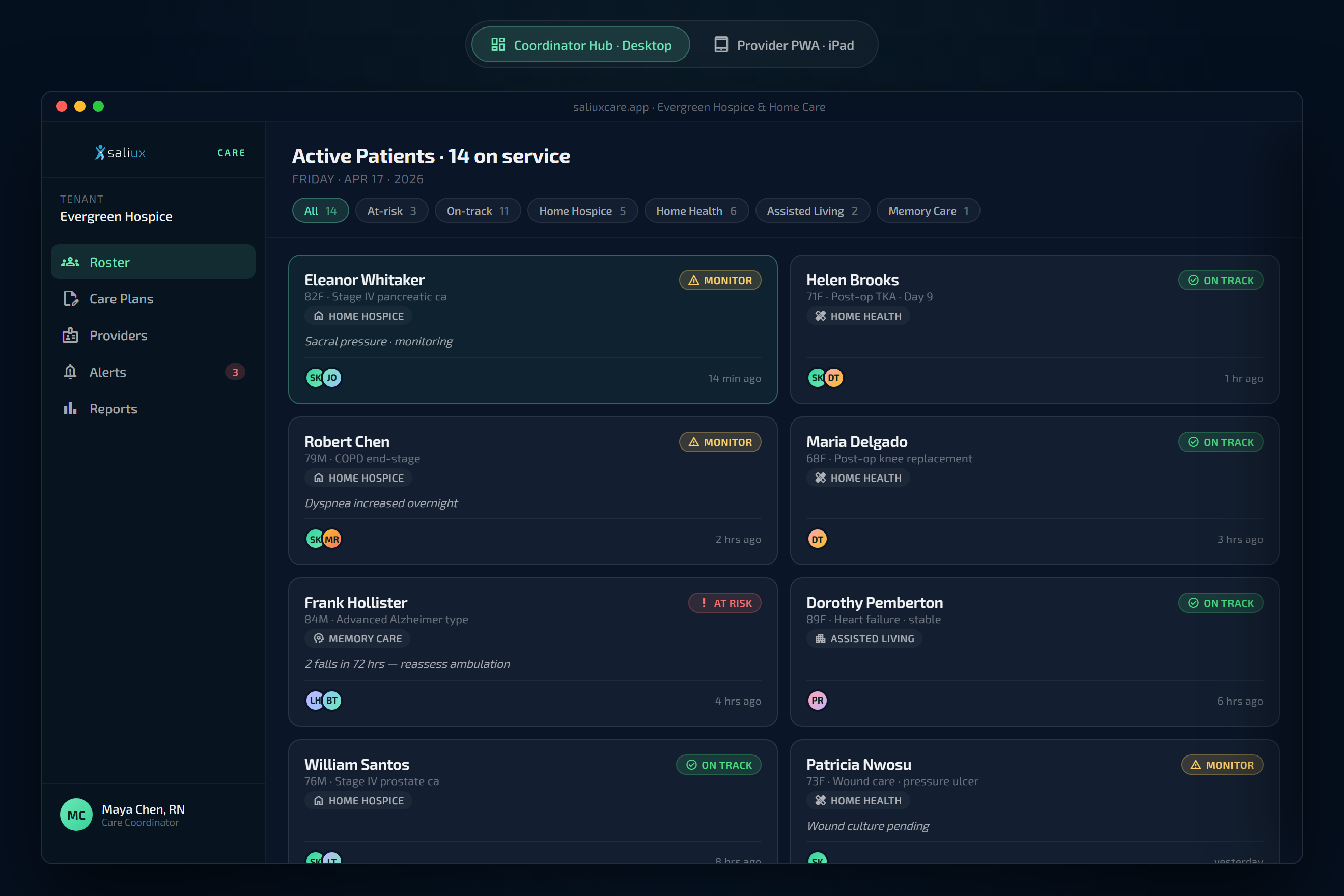
A single dashboard showing every active patient, every assigned caregiver, and every care obligation — across the entire patient census, in real time.
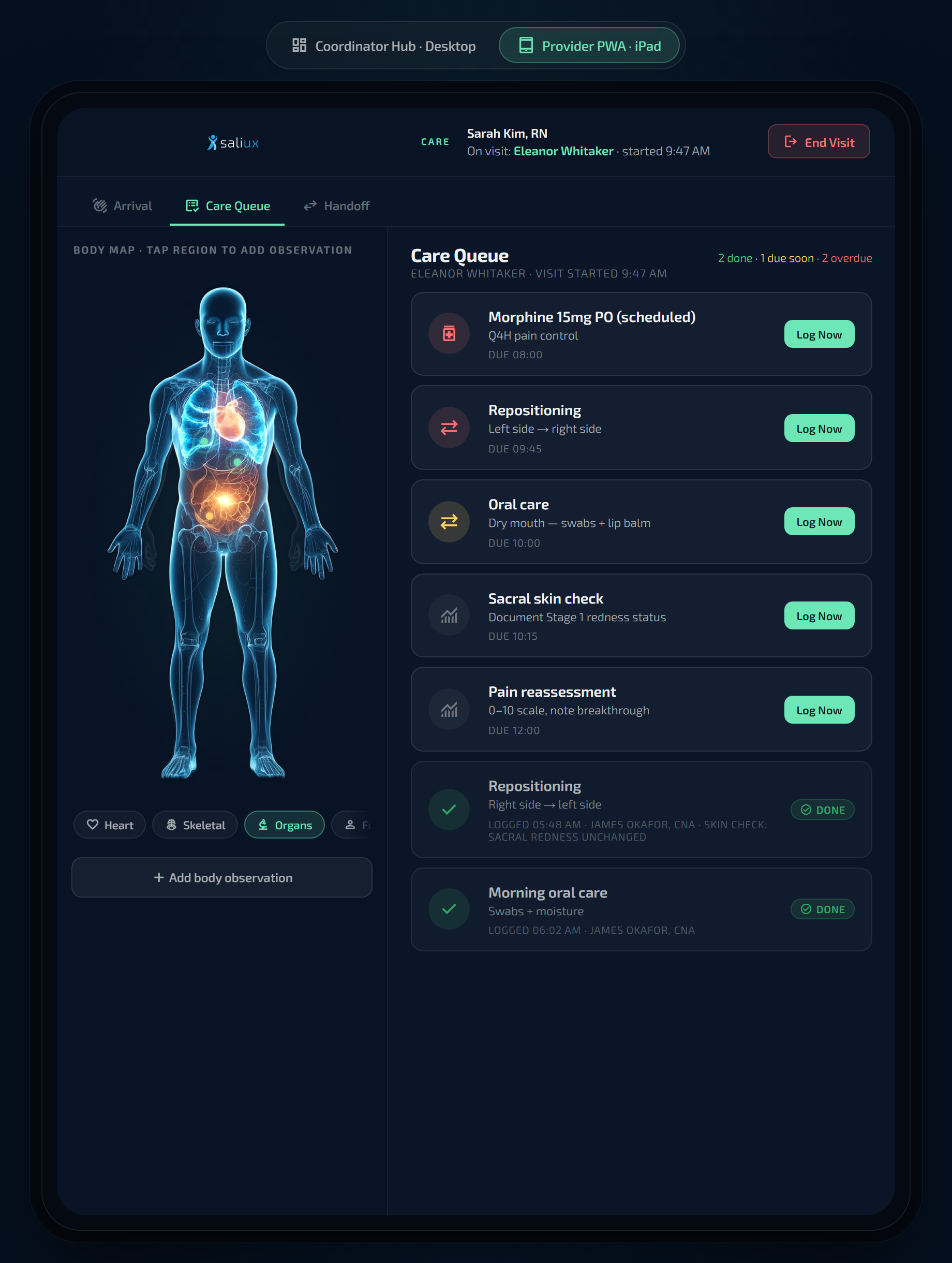
A mobile-optimized progressive web app for field caregivers. Their daily patient schedule, current care queue, and the clinical context they need — available offline, updated in real time when connected.
A read-only web view for family members and designated contacts. Not a chat interface — a transparent log of what has been done for their loved one and what is coming next.
Every care event has a body system, a timing requirement, and a completion state. Saliux Care renders the full care cycle — what was last done, what is next due, what is overdue — anchored to the body system it belongs to. Green. Amber. Red. No ambiguity about what needs attention now.
Medications, wound care, positioning protocols, feeding schedules, physical therapy, respiratory care — each mapped to the body system it addresses. A caregiver managing post-surgical wound care understands context, not just a checklist item. Care becomes coherent rather than procedural.
When a shift ends or a patient's care transitions to a different provider, Saliux Care generates a structured handoff brief — what was done, what is pending, what is due next. No verbal relay. No context loss. The incoming caregiver arrives knowing what they are walking into.
For patients coming from a VPI-connected facility, the care cycle from clinical discharge transfers directly into Saliux Care. Medications, follow-up obligations, and the 30-day readmission window carry over. The post-acute team receives the clinical context they need without a fax or a phone call.
Visiting nurse services, personal care aides, home health aides managing complex post-discharge patients in their own homes.
Residents with ongoing medication management, therapy schedules, and chronic condition monitoring across rotating care staff.
Specialized care facilities where consistent care routines, medication precision, and family visibility are critical safety factors.
Independent and semi-independent residents with care needs that span wellness, medication management, and clinical follow-up.
Comfort-focused care coordination where family involvement, care transparency, and provider continuity carry the highest weight.
Saliux Care is role-aware at every level. Information density is calibrated to the person receiving it — the coordinator hub carries the full clinical and operational picture, the caregiver view surfaces the current task context, and the family view presents a clear, readable log without clinical noise. The patient's record is the single source of truth. Every role accesses the same data, through the lens that serves them.
The most dangerous moment in a patient's recovery is the transition from hospital to home. It is when the structured, monitored care environment ends and the fragmented, informal one begins. Medications get missed. Follow-up labs don't happen. Wound care protocols aren't followed consistently. The patient is readmitted within 30 days.
Saliux Care is designed for this transition. The care obligations that VPI was tracking in the hospital — medications, wound care schedules, follow-up lab orders, activity restrictions — transfer at discharge into the Saliux Care coordinator hub. The home care agency receives a structured care plan, not a summary document. The caregiver arrives with context, not a clipboard.
This is not post-discharge outreach. It is care continuation. The same care cycle. A new setting.
Medications, wound care, temporal obligations, recovery trajectory — all tracked body-system-anchored in VPI throughout the inpatient stay.
At discharge, the active care cycle moves from VPI into Saliux Care. The coordinator receives a structured care plan. Nothing is lost in the handoff.
The coordinator manages the full post-acute care plan from the hub. Caregivers execute against it. The family observes. The 30-day readmission window is tracked and visible to everyone.
Saliux Health gives the patient visibility into their own care cycle — medications due, upcoming visits, recovery milestones. The same record, their own view. Owned by them permanently.
Saliux Care is the second interface in the Saliux platform — connecting the clinical world of VPI to the personal world of Saliux Health. The patient's record travels through every care setting they enter. The organization that managed their care before you built the foundation. You build what comes next.