Patient Health App · Three Patents Pending

The record belongs to you.

Saliux Health is the patient's own surface on the Saliux platform — a body-mapped view of your record, the care your team is performing, and full control over who reaches that record. Yours, permanently. Activated at any care transition, or provisioned by you from home — no subscription, no surprise bill.
Saliux Health — patient body map home screen
summarize

After discharge, you get a summary. The record stays in the hospital.

The clinical picture assembled during your admission — active conditions, medications, care obligations, physician decisions — is inaccessible the moment you leave. You receive a summary document. The record that informed every decision remains inside a system you can't reach.

join_left

Every new provider starts a blank file.

The record your last physician built doesn't follow you to the next one. Each care relationship begins with re-entry: the same conditions, the same medications, the same history, entered again. The longitudinal picture that would change every clinical decision exists nowhere in a form you can carry.

visibility_off

You sign consent. Then it leaves your hands.

At admission you sign authorization forms and from that moment they operate in systems you can't see — who used them, when, for how long. Institutions keep their records and their own consent logs, as they must; nothing about that changes. What's missing is a record you hold, with its own consent ledger. Saliux Health gives you that: every provider you authorize, every scope you grant, every access they make to your record — on your side, in your control.

Saliux Health home screen
home
For patients
Your whole body. Everything in view.

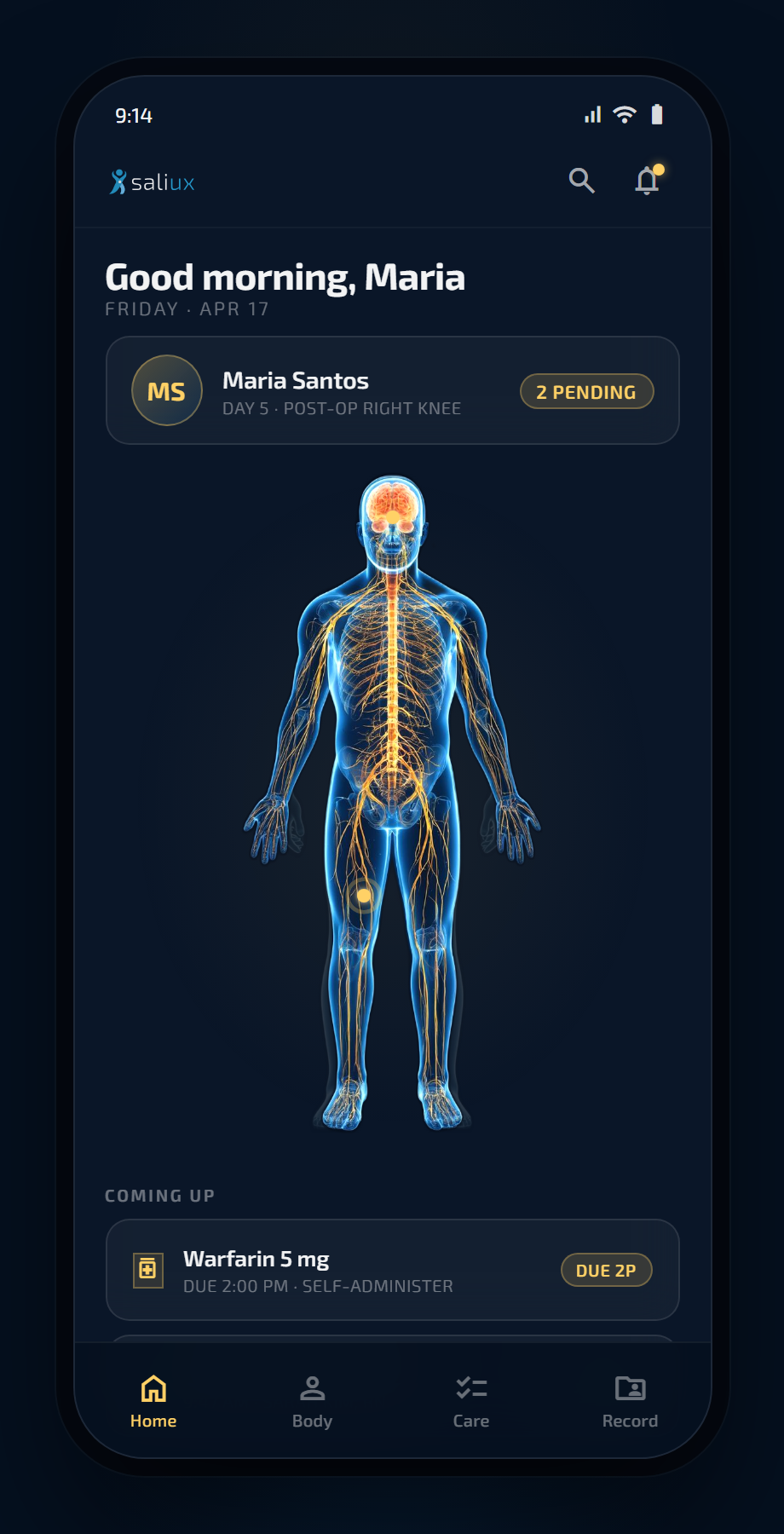
The home screen maps your active conditions to their anatomical locations — not a problem list, a body picture. The salience engine surfaces the conditions most relevant to your current care context at the top of the hierarchy. The Saliux Agent presents observations from your longitudinal record without making decisions or sending unsolicited recommendations to your care team.

The sync timestamp tells you exactly when the record was last updated — down to the minute. When your care team logs a completed routine, it appears here immediately. You are not reading a static snapshot; you are reading the live record.

Saliux Health body map view
accessibility_new
Body-anchored view
Tap a marker. See what the care team sees.

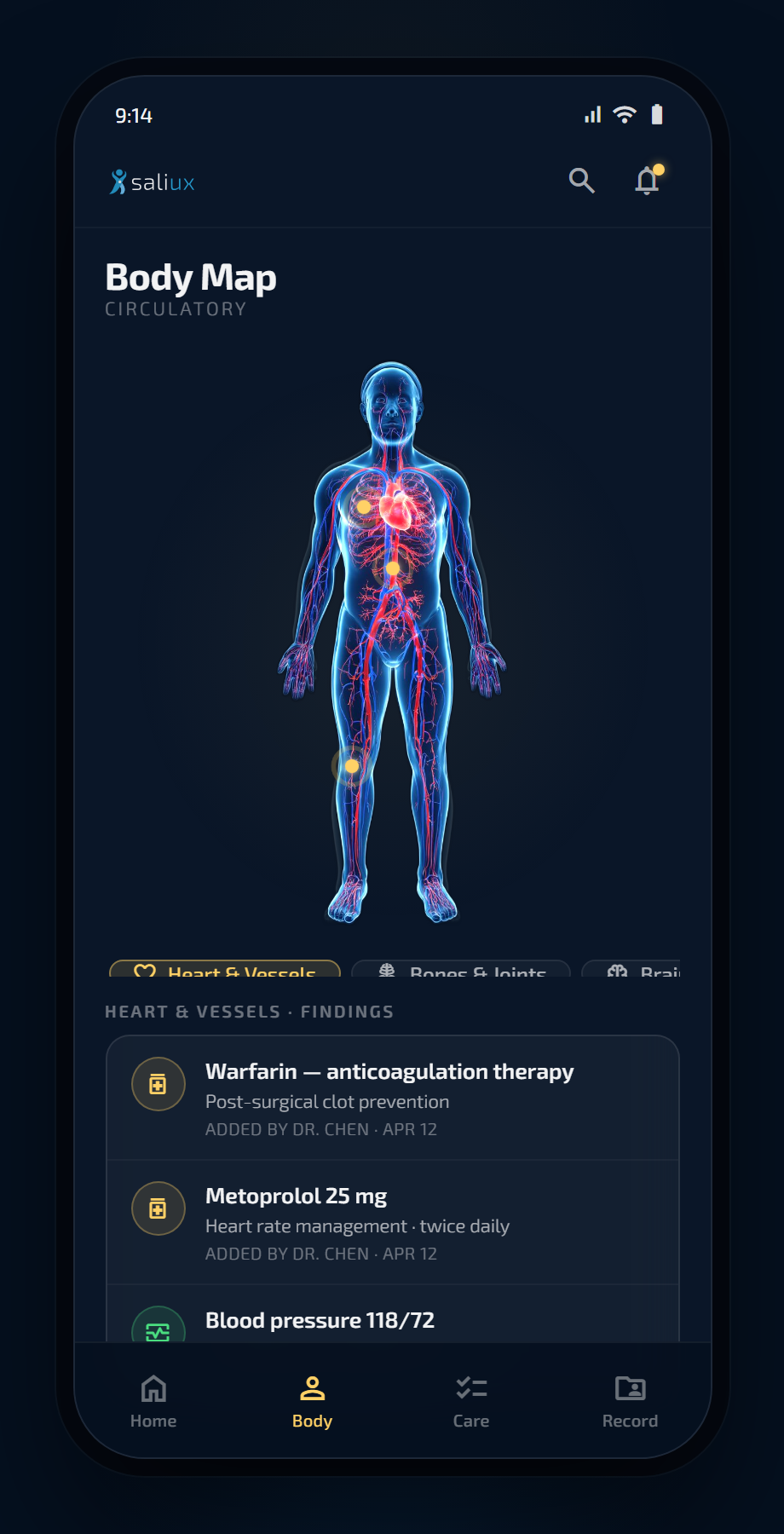
Every active condition and care obligation is anchored to its anatomical location on the body map. Salience-weighted markers show visual prominence based on role context, acuity, encounter relevance, and temporal state — the same weighting your clinical team sees in VPI. Anatomy as interface.

Tap any marker to view condition detail, the care acts attributed to that location, and any active obligations. The body map is not a diagram. It is a navigable index of your health record, organized by where things are happening in your body rather than how they were entered into a system.

Saliux Health care view
medical_services
Care team activity
What was done. When. By whom.

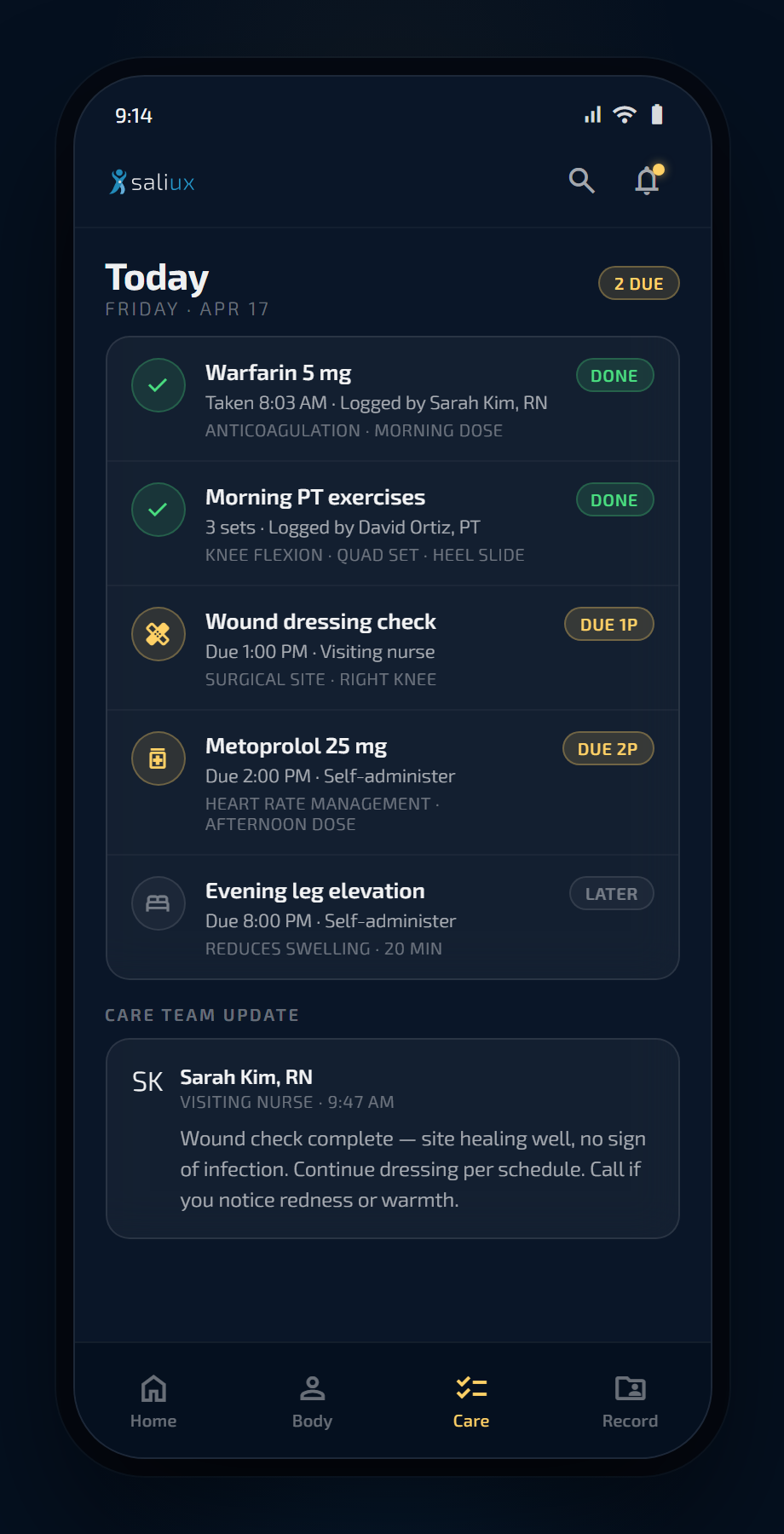
The Care View surfaces every act your care team has logged — completed routines, vital observations, medication administrations — in real time. Each entry is attributed to the provider who logged it and timestamped to the minute. When your visiting nurse completes a wound care routine, it appears in your record before they've left the room.

You are not a passive recipient of care; you are a participant in the record that describes it. The same activity feed your care coordinator sees is visible to you — attributed, timestamped, and written in plain language. No clinical abbreviations. No systemic opacity.

Saliux Health record and access management
lock_person
Access management
Who has access. What they can see. Your call.

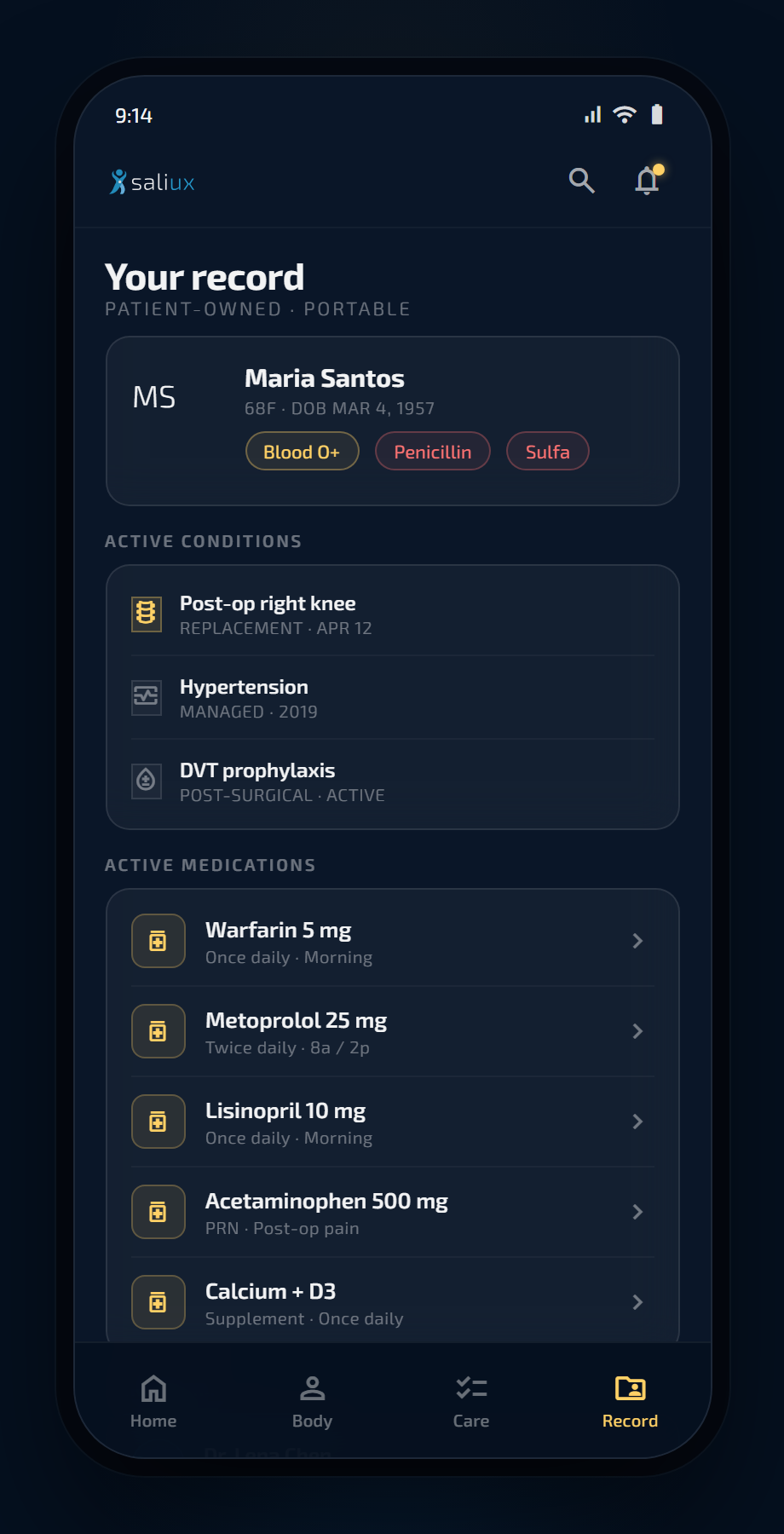
The Record screen lists every provider and institution currently authorized to access your health record — what they can see, what they can write, and when that authorization was granted. Revoke any access at any time with immediate effect. Grant new access during a care enrollment.

The scope of every authorization is explicit — no implied or administrative access exists outside what you've approved. Patient Data Sovereignty is not a policy statement. It is a button. The record is yours to share, scope, and reclaim on your own terms, at any moment in your care arc.

From your couch. Without a clinic visit.

You don't need a hospital to activate your record. Sign up for Saliux Health from home, connect the providers you've already seen, and pull your longitudinal history into a record you hold. Saliux Health authenticates you at each provider's existing patient portal — MyChart, HealtheLife, FollowMyHealth — and retrieves your labs, medications, conditions, allergies, procedures, immunizations, and visit notes via the same FHIR endpoints every certified EHR now exposes. You do the work once. Background refresh keeps the record current.

This is what 21st Century Cures Act interoperability looks like used. Apple Health Records proved patients will do it. Saliux Health is built around it.

SMART on FHIR 21st Century Cures Act USCDI
home

Continuity without a new visit

Moving to a new primary care physician, or seeing a specialist for the first time? Arrive with your history already in hand. The new provider reads your record with your authorization — no intake form, no re-entry, no gaps.

verified

Proof, when it's asked for

Immunization verification for employment or school, travel documentation, pre-procedure history review — share scoped, signed evidence directly from your record. No uploading photos of paper cards. No logging into each provider's portal separately.

timeline

Longitudinal by default

Complex history across multiple providers is no longer scattered. Blood work from one health system, imaging from another, medications prescribed by a third — all aggregated into one body-mapped view of your health, moving with you as you do.

Provisioned at transition. Yours from that moment forward.

Saliux Health doesn't maintain a separate patient database. It is the patient-facing surface on a FHIR record the patient owns — activated at a care transition and held by the patient permanently. The clinical picture built during a hospital admission, the care acts logged by a home health team, the readings the patient self-logs — all write to the same record, through authorized surfaces, in real time.

When care ends, the agency's access ends. The patient's record remains. It travels to the next care relationship the patient authorizes, carrying the longitudinal history every new provider would otherwise have to reconstruct from scratch.

HL7 FHIR R4 Patient-owned PHR FHIR Subscriptions
1

The record is activated — from either direction VPI

VPI activates the record at hospital discharge — the clinician writes the bundle, Saliux Health is provisioned, the patient leaves with the admission's clinical picture already populated. Or the patient activates it themselves from home by connecting their existing providers via SMART on FHIR. Either path yields the same record.

2

Care team activity writes in real time Care

Every routine logged by a visiting nurse, every care plan update confirmed by a coordinator, every observation — lands in the patient's record immediately. Attribution, timestamp, and plain-language description included.

3

The patient adds their own data

Blood pressure readings, symptom logs, medication adherence notes — patient-self-reported data is attributed explicitly as patient-entered and visible to the care team before the next visit. Embodiment V of the FHIR flywheel.

4

The record travels to the next relationship

When care ends, access ends. The record remains — held by the patient, portable to any provider they next authorize, independent of institutional boundaries or proprietary data locks.

Patient Data Sovereignty.

The patient's health record belongs to the patient. Architecturally. Saliux Health is not a portal where a health system grants you a view of your data. It is the record itself — held by the patient, authorizing providers rather than being authorized by them. Every provider who accesses your record does so under explicit authorization you granted, scoped to what you chose to share, revocable at any time without a phone call or a form.

This is not a privacy statement. It is the architecture. The record is a FHIR R4 server instance on Saliux-operated infrastructure — operated by Saliux, owned by the patient. When a patient revokes a provider's access, what ends is that provider's ability to read and write to the patient's record; institutional records are unaffected. The record stays with the patient, is portable to another custodian if needed, and travels to every care relationship that follows. This is what 21st Century Cures Act interoperability looks like when it's built patient-first rather than institution-first.

Display Never Decide.

The Saliux Agent surfaces observations from your longitudinal record — patterns across conditions, timing correlations between care adherence and clinical trajectory, gaps the care team may not have flagged. It presents findings for your review. It does not act on them. No recommendation reaches your care team without your explicit confirmation. No clinical suggestion is framed as a decision you must make.

This is the platform's AI posture — architectural, not aspirational. The AI layer exists to inform human judgment, not substitute for it. Every Saliux Agent output is labeled as a suggestion, carries a confidence indicator, and requires a human confirmation event before any state changes in the record. The patient is not a downstream recipient of AI decisions; they are the decision-maker the AI layer is designed to inform.

Three interfaces. One data layer. The record travels.

For clinical teams

Visual Patient Interface

Whole-body clinical visualization at the acute point of care. At discharge, VPI writes the bundle that activates the patient-owned record every post-acute relationship builds on.

Explore VPI
For post-acute care

Saliux Care

Coordinator Hub, Provider PWA, and Family Portal — three surfaces reading and writing to the patient-owned record, in real time, across the full post-acute arc.

Explore Saliux Care
For patients

Saliux Health

Body map, care obligations, activity feed, and access management — the patient's own view of the record that every other interface reads and writes.

You are here

Building for patients means starting with the record they own.

Saliux Health is in active development, provisioned through health system and home care partnerships. If you're building for patient populations, we want to hear from you.